Showing posts with label Procurements - Navy. Show all posts

Monday, June 26, 2017

New 155 mm howitzers of the Philippine Army, and Marines

The Philippine Army
"The M101 remained a fixture across Southeast Asia where it was continuously employed by the militaries of the Philippines, xxx. The Philippine Army in particular never let go of its Vietnam-vintage M101’s in its long battle against restive Muslims in Mindanao." "The M101’s career is far from over. It remains in the arsenals of at least a half dozen Latin American countries and is found throughout Asia. Whether marking a national holiday with a salvo or pounding terrorist camps in the Southern Philippines the M101 hasn’t become redundant. With its literal impact on modern history it is apparent the roar of the M101’s thunder will echo for years to come (http://www.military-today.com/artillery/m101.htm)."

The Philippine Army primarily uses 105 mm howitzers, the standard howitzers of the Philippine army are the M101 105 mm howitzer, a WW II howitzer of the United States of America first known as the M2 105 mm howitzer, the M2 105 mm howitzer was later on re-named after WW II, the howitzer is then made available for re-production after the war, and has been sold to allied customers throughout the world. 


The Philippine Army also has some 155 mm howitzers but they barely use it on actual military operations, and they are not the newly acquired 155 mm Soltam howitzers, the 105 mm is not a bad gun, but the thing is it is not as powerful as compared to the 155 mm howitzer. 


That is because a 155 mm howitzer has more power and it has a longer range as compared to a 105 mm howitzer, for that reason alone the Philippine Army could already fire artillery barrages to enemy forces that are positioned two times farther.


The additional fire power and range, is a changing factor in the war zone/battlefield, I am glad, and proud that our armed forces acquired the Soltam 155 mm howitzers, the camouflage patterms is also unique.

 Elbit-Soltam M-71 155mm/Towed 39CAL howitzers, MaxDefense Philippine

The Philippine Marines


The Philippine Marines will also receive their own 155 mm Soltam howitzers, in fact the marines already received their 155 mm Soltam and it is already deployed at Marawi to help in the fight against the Maute Group, according to a AFP Modernization Today member, the marines did operate some 155 mm howitzers once in the past, some were donated by the US armed forces to the Philippine Marines. The said howitzers are placed at a base at Luzon, possibly for storage, and display or for the war museum of the armed forces of the Philippines. 


The primary operators of howitzers in the country are the Philippine Army only, that is the reason why we could not really tell that the Philippine Marines did operate any howitzers, however the Philippine marines uses mortars for artillery support, but all of that are about to change, because of the new 155 mm Soltam howitzers acquisition of the Philippine Marines. The gun is an added fire power for the marines, it is a good choice by choosing the Soltam 155 mm howitzers.


 Elbit-Soltam M-71 155mm/Towed 39CAL howitzers, .gmanetwork.com
Here you could spot a Elbit-Soltam M-71 155mm/Towed 39CAL howitzers that is already deployed at Marawi to help fight off terrorists and rebels, according to GMA news, the link to the said report is at the pictures' caption.
Here is the basic specification of the Elbit-Soltam M-71 155mm/Towed 39CAL howitzers;


Main weapon caliber (mm)
155
Barrel length (calibres)
39
Weight (kg)
9200
Length (mm)
7500
Width (mm)
2580
Height (mm)
2115
Ground clearance (mm)
380
Track (mm)
2200
Elevation (degree)
52
Depression (degree)
-3
Track (mm)
84
Rate of fire (rds/min)
5
Firing range (m)
23500
Crew
8


"The Soltam Systems towed 155 mm M-71 gun-howitzer is a further development of the Soltam Systems towed 155 mm M-68 gun-howitzer and uses the same recoil system, breech and carriage. The first prototype was completed in 1974 and first production units the following year. The main differences between the M-71 and the M-68 are that the former has a longer 155 mm/39 calibre barrel and is fitted with a rammer driven by compressed air. This permits rapid loading at all angles of elevation. The rechargeable cylinder for the M-71 is mounted on the right trail. The barrel has 48 grooves, length of rifling is 5.038 m, width of groove 6.6 mm, width of land 3.5 mm and depth of groove is 1.2 mm." 

"Soltam systems is now concentrating its marketing on the latest 155 mm TIG 2000 artillery system which is available with a 39, 45 or 52 calibre ordnance. Details of this system, which is understood to have been developed for the export market, are given in a separate entry. Details of recent Israeli 155 mm artillery exports through 2006 are provided in the entry for the Soltam Systems 155 mm TIG gun-howitzer family." 
The howitzers have already been tested at the 2017 Marawi seige at the Philippines. The Philippine-United States of America military exercises will help develop, and improve the skills of the Philippine soldiers on handling this type of weapons, the Philippine Armed Forces already did train with the most modern 155 howitzer in the world and that is the M777 155 mm howitzers of the US armed forces, although it would be better if both forces would train on the M71 soltam 155 mm howitzers next year at 2018, that is because such military exercises will improve further the skills of the Filipino artillery men, and soldiers on how to operate such devastating weapon. The acquisition of the M71 Soltam 155 mm howitzers is a moral boosters for the Philippine Army, and Philippine Marines, we are exited to see the M71 Soltam 155 mm howitzers of the Philippine Army, and of the Philippine Marines get tested during live military exercises.

Here is the report about the 155 mm howitzer acquisition of both the Philippine Army, and Philippine Marines, click the link for the report.
Subscribe to our Youtube channel: Philippine Military Analysis and Updates and watch the FA-50 and the GDP class Frigates

       
Share:

Friday, June 2, 2017

"Rafael Typhoon Spike ER MLS - Non Firing Display Unit was presented to President Rodrigo Duterte aboard the BRP Davao Del Sur during the Philippine Navy's 119th Anniversary.

Actual Firing Unit will be delivered at 4th Quater of 2017 and will be installed on Multi Purpose Attack Craft Mark 3( MPAC Mk3 ).

Spike ER is an Anti Tank Missile with 8km range and will be used by the Navy as an Anti Surface weapon.

Spike ER Missile will be the very first missile to be used by the Navy and second by the AFP after the old AIM-9B Sidewinder Missile

Photo Credits to the Owner." -Admin One Skies

Rafael Typhoon Spike ER MLS, (C)

According to MaxDefense Philippines, a .50 cal Remote Controlled Weapons System machine gun will be armed to the Multi Purpose Attack Craft MK III of the Philippine Navy along with the Rafael Typhoon Spike ER MLS that fires Anti-Tank Missiles (Surface to Surface Missiles) that the Philippine Navy will use as a Anti-Ship Missile (ASM-ASW). 

The Multi Purpose Attack Craft MK III (Missile Firing Fast Attack Craft) will be used as a armed escort of the troop transport variant the MPAC MK I and the MPAC MK II. 


Share:

Navy's Strategic Sea Lift Vessel (SSV) in Action

The Strategic Sea Lift Vessel of the Philippine Navy delivered logistical support and supplies to Marawi city the city was previously besieged by members of the Maute Group. The picture below shows the Armored Personnel Carriers (APC) of the Philippine Army (Belgian M113A2 but were used by the US armed forces and was later on donated to the Armed Forces of the Philippines) armed with .50 cal Remote Controlled Weapons Systems, .50 cal Machine Guns, and 25 mm Cannons.

M113A2 armed with .50 caliber machine gun, VJDefense.com

M113A2 armed with 25 mm cannon. VJDefense.com
M113A2 armed with .50 caliber machine gun, VJDefense.com

Here are some of the pictures of the M113A2 of the Philippine Army that were sent into battle at Marawi.


Subscribe to our Youtube channel: Philippine Military Analysis and Updates

Like our page: Philippine Military Analysis and Updates


Share:

Sunday, May 28, 2017

PN's second SSV, BRP Davao Del Sur, to be commissioned May 31


MANILA, May 21 — The Philippine Navy's second strategic sealift vessel, the BRP Davao Del Sur (LD-602), will be formally commissioned on May 31 at Davao City's Sasa Wharf in line with the celebration of PN's 119th founding anniversary.
This was revealed by PN spokesperson Capt. Lued Lincuna in an interview with the PNA Saturday.
He added that President Rodrigo Duterte is expected to attend the ceremony as guest-of-honor and speaker along with other ranking defense and military officials.
The BRP Davao Del Sur arrived off South Harbor, Manila last May 8 after departing from the PT PAL (Persero) shipyard in Surabaya, Indonesia last May 4.
She was named after the province of Davao Del Sur, the home of the country's highest peak Mount Apo and other rare species of flora and fauna.
"It gives due recognition to the province as sanctuary of natural wonders and rarities like the country’s highest peak Mt. Apo, the most prized Philippine orchid Vanda Sanderiana, and the endangered Philippine Eagle," Lincuna said,
Also, the namesake takes inspiration from a former PN vessel of the same name notable for its accomplishments during during the 1980s.
"Naming the vessel after Davao Del Sur is consistent with its predecessor, BRP Tarlac (LD-601), which was also named after a province," Lincuna added.
The ship was launched last Sept. 29. She is the sister ship of the BRP Tarlac (LD-601), currently the largest Filipino warship in commissioned.
BRP Tarlac was commissioned during short ceremonies at Pier 13, Manila South Harbor last June 1.
She arrived in the Philippines last May 14 after a five-day journey from PT PAL shipyard in Surabaya which started on May 9.
BRP Davao Del Sur is also a Makassar-class landing platform dock like her sister ship BRP Tarlac.
Its delivery completed the two-unit SSV procurement project with an approved budget contract of PHP4 billion sourced from the AFP Modernization Act Trust Fund.
Just like the BRP Tarlac, the PN's latest SSV will serve as a floating command-and-control ship especially in the conduct of humanitarian assistance and disaster response and will also serve as a military sealift and transport vessel.
The ship has an overall length of 120 meters,breadth of 21 meters, draft of five meters and can carry a payload of 2,800 tons.
She has a cruising speed of 13 knots and maximum speed of 16 knots and a minimum operating range of 7,500 nautical miles.
BRP Davao Del Sur can carry 500 troops, two rigid-hull inflatable boats, two landing craft units and three helicopters. (Priam F. Nepomuceno/PNA)
Share:

Friday, May 26, 2017

Russia asks Philippines to submit shopping list of defense equipment

Foreign Affairs Sec. Alan Peter Cayetano meets with Russia Foreign Minister Sergey Lavror in Moscow. The STAR/Alexis Romero
MOSCOW – Russia has asked the Philippines to submit a shopping list of defense equipment after President Rodrigo Duterte urged Russian President Vladimir Putin to provide him with a loan to buy firearms.

Foreign Affairs Secretary Alan Cayetano said the Russian government was willing to “do all efforts” to accommodate Duterte’s request.

“The response of the Russian Federation through President (Vladimir) Putin was very, very generous. So they said, well, we have the framework in place through our agreements to cooperate,” Cayetano said in a press briefing Wednesday night here.

“They have showed us what is available to us. I’m not at liberty now to discuss that…but they are awaiting our proposals,” he added.

While there was no decision yet on the loan being sought by the Philippines, Cayetano said Russia has provided help to countries that it considers as friends.

“It’s nothing new for the Russian Federation to lend a helping hand to countries that are their friends,” the Foreign Affairs chief said.

Duterte asked Putin for a soft loan during their bilateral meeting in Kremlin last Tuesday, hours before the Philippine leader left for Manila. Duterte said he needed money to buy firearms as the Philippines’ rifle deal with the US had been scrapped.

The US State Department halted the sale of some 26,000 rifles to the Philippine police last year after Democratic Sen. Ben Cardin had raised issues about the Duterte administration’s human rights record.

Cayetano said the loan may be used to buy not just firearms but to acquire equipment that would improve the chances of survival of government troops.

“These are really modern equipment that can be used to fight terrorist that will avoid injuring or causing deaths or damage or deaths to innocent bystanders or people in a community and also to prevent collateral damage,” Cayetano said.

“That also goes, for example, for our police and our military. You know, they’re suffering. They’re getting hurt. They don’t have the best hospital equipment. Sometimes, the Abu Sayyaf have better equipment than they do,” he added.

Duterte also invited Putin to visit the Philippines during their bilateral meeting.

Cayetano said Putin had expressed his gratitude to Duterte for the invitation. It was unclear whether the Russian leader accepted the invitation but Cayetano said such invitations do not usually get immediate response.

Russian Prime Minister Dmitry Medvedev is expected to come to the Philippines in November to attend the Association of Southeast Asian Nations summit and related summits. 

SOURCE: Philippine Star
Share:

Sunday, May 21, 2017

PH, Russia to sign defense deal during Duterte visit

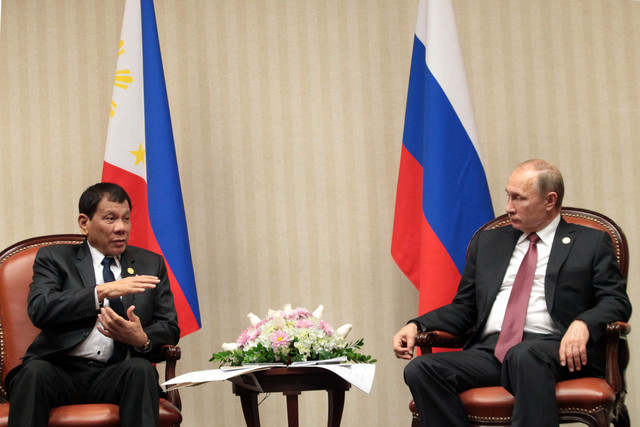
FIRST MEETING. Philippine President Rodrigo Duterte and Russian President Vladimir Putin meet for the first time during the APEC Summit in Peru in 2016. Malacañang file photo

FIRST MEETING. Philippine President Rodrigo Duterte and Russian President Vladimir Putin meet for the first time during the APEC Summit in Peru in 2016. Malacañang file photo
MANILA, Philippines – The Philippines and Russia will sign a defense cooperation agreement and other bilateral deals when President Rodrigo Duterte goes on a 5-day official visit to the country next week.
Duterte will visit the cities of Moscow and St Petersburg during his visit from May 22 to 26, and will be accompanied by several Cabinet officials and a large business delegation, Foreign Assistant Secretary Maria Cleofe Natividad said in a Palace briefing Friday, May 19.
Natividad said deals expected to be signed during the visit include a defense cooperation agreement, a memorandum of understanding on cooperation between Russian and Philippine security councils, a treaty on mutual legal assistance in criminal matters, and an extradition treaty.
The defense agreement, which will deal specifically with "military and technical cooperation," will set the stage for the Philippines' possible acquisition of defense assets from Russia.
"The agreement on military technical cooperation will pave the way for the Philippines to explore a possibility of military procurement from Russia," said Natividad.
Defense Secretary Delfin Lorenzana had earlier confirmed he would sign a defense cooperation deal with Russia's defense ministry involving information sharing, training, and technical cooperation.
Another expected outcome of the visit is the establishment of a Philippine Office of Defense Attaché in Moscow and a similar Russian office in Manila.
Highlights
The other highlights of the visit include a bilateral meeting between Duterte and his "idol," Russian President Vladimir Putin, a bilateral meeting with Russian Prime Minister Dmitry Medvedev, and a visit to a St Petersburg military shipyard. 
Duterte will also have a gathering with the Filipino community in Russia and nearby states. The growing number of Filipinos expected to attend the event has prompted organizers to change the venue, Natividad said.
The Philippine leader will also give a speech at Russia's Moscow State Institute of International Relations (MGIMO), a world-renowed diplomatic school.
He is expected to "articulate his admininstration's commitment to pursue an independent foreign policy," said Natividad.
Official vs state visit
Unlike Duterte's first visit to China, his Russia visit will only be an official visit, and not a state visit.
An official visit is considered a level lower than a state visit in terms of ceremony and importance.
However, Natividad said "this is as important as a state visit if you look at the quality of meetings the President will be having with Russian officials."
The decision on the type of visit was made by the Russian government as the inviting party. But Natividad is confident that Russia will still give Duterte a red carpet welcome.
She also emphasized the significance of the visit as it is upon the invitation of Putin himself.
The last Philippine president to visit Russia upon the invitation of its leaders was Fidel Ramos.
The formal invitation to Duterte reached the Philippine government as early as January but due to Duterte's busy schedule, which included hosting an Association of Southeast Asian Nations Summit, the visit had to be pushed back.
Another important factor that influenced the date of the visit was Russia's climate. Natividad admitted they waited for "good weather." Duterte previously spoke of an aversion to visiting countries during the cold season– Rappler.com
SOURCE: Rappler
Share:

Sunday, January 22, 2017

Service Advisory - Labels on Procurements

Please be notify that the AFP MT is improving its page in order to serve its readers better. In this case, we will introduce several changes which involves search results on procurement of military weapons pertaining to AFP.

Instead of one, there will be five series of procurement, naming:

Procurement (Army)
Prourement (Navy)
Procurement (Air Force)
Procurement (Coast Guard)
Procurement (Others)

ALSO...

Service Advisory Tabs will be included on the News Tab while Procurements will be having another series of tabs on the main links bar.

Thank you, and happy reading.


Share:

Tuesday, January 10, 2017

Hyundai wins USD337 million frigate contract from Philippine Navy

Infographic of PMMT, a CGI of the Incheon class HDF-3000 FFX-I (modified for the Philippine Navy), HHI


Key Points

  • Hyundai Heavy Industries has been selected to supply the Philippine Navy with two newbuilding frigates
  • Programme will provide the Philippine Navy with its most modern surface combatant to date
South Korean shipbuilder Hyundai Heavy Industries (HHI) has formally received a notice of award from the Philippine government to build two new frigates for the Philippine Navy (PN).

The notice, which indicates a contract price of PHP15,744,571,584 (USD337 million), was signed by Secretary of National Defense Delfin Lorenzana and addressed to the senior general manager for HHI's special and naval shipbuilding division, Ki Yeong Sung.

The Philippine Department of National Defense (DND) first launched the two-ship frigate acquisition programme in October 2013 to meet the PN's long-range maritime surveillance, patrol, and interdiction capabilities.

HHI pitched the company's HDF-3000 multipurpose frigate design, which has been used as the basis for the Republic of Korea Navy's (RoKN's) Incheon (FFX-I)-class guided-missile frigates.

According to specifications provided by the company, the HDF-3000 design features an overall length of 114.3 m, an overall beam of 14 m and a hull draught of 4 m. The platform has a standard displacement of approximately 3,000 tonnes and can accommodate engines in combined diesel or gas (CODOG) machinery arrangements.

The HDF-3000 design has a maximum speed of 30 kt, and a standard range of 4,500 n miles at the cruising speed of 18 kt. In terms of armament, the platform can carry a 127 mm naval gun, two anti-surface missile launchers mounted diagonally amidship, two triple torpedo tubes, and associated fire control systems.

The PN's weapons wishlist for the warships is currently unknown but an updated list of requirements for the frigate acquisition programme released by the DND in early 2016 calls for no degradation of anti-air and anti-surface capabilities at Sea State 5, and no degradation of anti-submarine warfare capability at Sea State 4.


Share:

Wednesday, November 9, 2016

Philippines positions new frigates as primary ASuW platforms

The word ASuW according to Janes means Anti-Submarine Warfare, warships that is labelled as ASuW warships usually carry a lot of Anti-Submarine Warfare weapons and commonly most Anti-Submarine Warfare warships are designed for such role as designated to them by their respective navies or manufacturers.

Photo: Project 23420 Small Antisubmarine Warfare Ship, with a gun mount, either 76-mm AK-176MA or 30-mm AK-306, turret mount with ZM-47 Gibka antiaircraft missiles, two 12.7 machineguns, and either the Paket-E/NK antisubmarine torpedo system or the RPK-8E antisubmarine missile аnd depth bomb system, MilToday 

But... Not the Incheon class frigate of Hyundai Heavy Industries (HHI) that is being offered to the Philippine Navy (PN), according to Janes the weapon system of the Incheon class frigate are two triple torpedo tubes, each located on the port and starboard sides, an eight-cell vertical launching system (VLS) installed at the forward section,a 76 mm primary weapon, and four (two twin) anti-surface missile launchers, a pair of MBDA-SIMBAD anti-air defence system turrets above the bridge, and lastly a Anti-Submarine Warfare helicopter, technically speaking the warship is an all around frigate not only intended and designed for Anti-Submarine Warfare. 


As you could see on the picture, the Anti-Submarine Warfare triple torpedo tubes, is located on the port and starboard sides of the proposed design, HHI CGI proposal. 

Is the designation a bad thing? 

No, it is not. That just mean that the PN sees the threat of submarines and they are maximizing their current assets on what seems to be a lapse on our territorial/external defense in general, in addition to that the PN is designating the GDP class as a Anti-Submarine Warfare frigate (based on the Phase II of the AFP modernization program) by then the GDP class could have Anti-Submarine Warfare weapons, similar to the proposed Incheon Class Frigates, Surface to Air Missiles (most probably it would be the MBDA-SIMBAD anti-air defence system turrets), a CIWS, and an upgraded AW-109 helicopter.

    PF-15, ZetaBoards     

The good news, and the bad news

The good news is the PN are planning to acquire submarines in the future for training and experience purpose, reportedly the PN would start on something simple and not so sophisticated and complicated to use, the bad news is since it is only for training and experience purposes (on how to run and operate a submarine) it wouldn't be the ideal attack submarine that we are dreaming of (in other words it might just be a small diesel powered submarine). 

   
A small submarine, for reference use only

The threat, these nuclear and diesel powered attack submarines of China  


Business Insider and ExtremeTech


Share:

Copyright © AFP Modernization Today | Powered by Blogger
Design by SimpleWpThemes | Blogger Theme by NewBloggerThemes.com